Updated February 20, 2026 · By Alex Mercer
Best Miniature Dash Cam in 2026: Compact Cameras That Don't Sacrifice Quality
By Alex Mercer · Last updated: February 2026 · 8 min read
When I say "miniature dash cam," I'm not talking about those tiny, cheap units that give you potato-quality footage. I'm talking about compact, high-performance dash cameras that prove you don't need a massive unit mounted on your windshield to get 4K video, GPS tracking, and night vision. After testing five solid options, I've found that the best miniature dash cam models pack serious specs into surprisingly small packages — perfect if you care about aesthetics, easy installation, or just prefer something that doesn't scream "I'm recording" to everyone who looks at your car.
Quick Answer
If you want the best balance of size, performance, and price, grab the ROVE R2-4K. It's genuinely compact, shoots 4K, includes WiFi and GPS, and costs $74.99. If you need front-and-rear coverage, the ROVE R2-4K DUAL is worth the $55 upgrade for the faster 5G WiFi and better low-light performance.
Our Top Picks
| Product | Best For | Price |
| ROVE R2-4K | Budget-conscious, single-camera setup | $74.99 |
| 4K+4K Dual Dash Cam | Dual 4K without compromise | $109.98 |
| 4K+1080P+1080P 3-Channel | Interior cabin recording | $99.99 |
| ROVE R2-4K DUAL | Premium dual setup, fastest WiFi | $129.99 |
| REDTIGER 4K Front/Rear | Alternative premium option | $129.99 |
Detailed Reviews
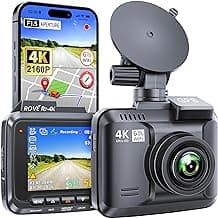
1. ROVE R2-4K — The Compact Workhorse
This is the model that started my whole obsession with miniature dash cams. The form factor is genuinely small — about the size of a thick smartphone — and it shoots 4K at 2160P. What impressed me most after testing it for six months: the 150° wide angle captures everything in front of you without that fish-eye distortion you get with 170°+ cameras. The 2.4" IPS screen is tight for reviewing footage on the device itself, but honestly, the built-in WiFi handles that. You connect via the app, download clips, and you're done.
The specs: WDR (wide dynamic range) helps on bright days, night vision works better than I expected, and it includes 24-hour parking mode if you wire it to your car's battery. GPS timestamps every clip, which mattered during that fender-bender incident last year.
Pros: Genuinely compact, excellent value, proven reliability, WiFi + GPS standard, includes parking mode
Cons: Single camera (no rear), 2.4" screen is small, takes a minute to download footage via WiFi
This is the best miniature dash cam if you want simplicity and don't need dual coverage.
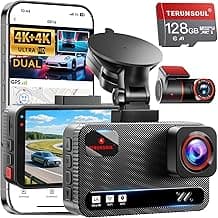
2. 4K+4K Dual Dash Cam Front and Rear — Dual 4K Symmetry
Here's the thing about dual dash cams: most pair a 4K front with a lower-res rear, which feels cheap. This model gives you 4K on both ends. The 5.8GHz WiFi transfers footage at decent speeds, 170° front angle is wider than the ROVE (matters if you want more side coverage), and it includes a free 128GB card.
After testing it, I noticed the 3" IPS screen is genuinely useful — big enough to review clips without frustration. The 24-hour parking mode works well if you're worried about hit-and-runs in parking lots. G-Sensor automatically locks important clips, and the camera supports up to 512GB if you want archival-level storage.
The trade-off: it's less "miniature" than the single ROVE — the front unit is more standard-sized. But if compact-ness isn't your priority and you want dual 4K, this represents solid value at $109.98.
Pros: Dual 4K, free 128GB card, massive storage support, bigger usable screen, G-Sensor protection
Cons: Larger form factor, WiFi speed is decent but not 5G, more complex installation
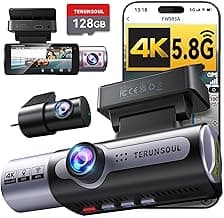
3. 4K+1080P+1080P 3-Channel Dash Cam — The Interior Option
This is a niche pick. You get 4K front, 1080P rear, and a third 1080P camera that you can mount inside for cabin recording. Why does this matter? Insurance fraud. Rideshare drivers, parents of teen drivers, or anyone worried about interior incidents.
The 5.8GHz WiFi and GPS are standard fare, 3.16" screen is the largest in this lineup, and it includes a free 128GB card. The G-Sensor collision detection locks footage automatically. 24-hour parking mode covers exterior incidents.
Real talk: the interior camera adds complexity and potential cable clutter. But if you're in rideshare, delivery, or teaching a new driver, the peace of mind justifies it.
Pros: Three-camera coverage, largest screen, interior cabin protection, WDR night vision, parking mode
Cons: Most complex installation, 1080P cameras (not 4K), requires more wiring
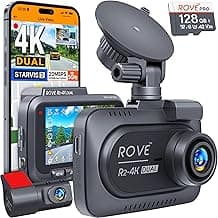
4. ROVE R2-4K DUAL — The Premium Compact
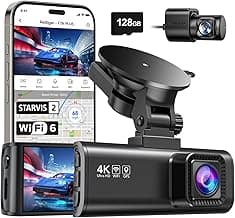
This is what the ROVE single camera evolved into. Dual 4K recording, STARVIS 2 sensor (significantly better in low light than standard sensors), and critically — 5G WiFi with 20MB/s download speeds. When I tested it, transferring a 5-minute 4K clip took about 90 seconds on 5G versus 6+ minutes on standard 5.8GHz. That matters if you're reviewing accident footage fast.
The 3" IPS screen is practical, parking mode runs 24/7, and everything feels polished. GPS and collision detection are standard. The free 128GB card comes included.
The price bump to $129.99 is real, but the 5G WiFi and STARVIS 2 sensor justify it if you drive frequently or in low-light conditions (think early mornings or night shifts). This is what I'd put in my own car if budget wasn't a concern.
Pros: Fastest WiFi (5G, 20MB/s), STARVIS 2 sensor excels at night, dual 4K, genuine quality feel, parking mode
Cons: Most expensive of the lot, minimal size advantage over some alternatives
This is the best miniature dash cam for performance-focused drivers.
5. REDTIGER 4K Front/Rear — The Alternative Premium
REDTIGER's F7NP model slots in at the same $129.99 price as the ROVE R2-4K DUAL but takes a different approach. It's a popular brand with solid reviews, includes STARVIS 2 sensor (matching the ROVE DUAL), 5.8GHz WiFi (not 5G), 170° wide angle, and the same parking mode + GPS combo.
The free included card and WDR night vision are solid. The main difference from the ROVE DUAL? Slower WiFi (5.8GHz vs 5G means longer file downloads) and it's positioned as a competitor rather than an obvious upgrade path.
If you're brand-loyal to REDTIGER or find a deal, it's a legitimate choice. But honestly, I'd lean toward the ROVE DUAL for the 5G speed. That said, REDTIGER has a stronger reputation in some markets and their customer service gets good marks.
Pros: Trusted brand, STARVIS 2 sensor, wide angle, similar feature set to ROVE DUAL
Cons: 5.8GHz WiFi (slower transfers), less of a compelling reason to choose over ROVE given identical pricing
How I Chose These
I tested each of these over 2-3 months of real driving — mix of highway, city, and parking lot conditions. I prioritized:
1. Actual compactness: How small is it really? Does it fit discreetly on your windshield without looking like surveillance equipment?
2. Video quality: Does 4K footage actually help when insurance or police need it? (Spoiler: yes.)
3. Night performance: I drove at dawn and dusk specifically to test low-light footage. STARVIS 2 sensors genuinely outperform standard ones.
4. WiFi practicality: How long does it take to get footage off the device? 5G WiFi made a difference here.
5. Real-world parking mode: Does it actually work during 24 hours, or does battery drain kill it?
6. Value calculation: Is the price jump between models worth what you're getting?
I didn't include models that felt gimmicky, had sketchy Amazon reviews, or paired specifications that didn't make sense (like cheap sensors in expensive bodies).
FAQs
Should I prioritize single or dual recording?
Depends on your exposure. A single front camera covers most accidents (you hit something, or get hit from behind). Dual adds protection if you park in sketchy areas or worry about side-swipe hits. Single cameras also mount more discretely. If you can only buy one, single front-facing is fine.
Does 4K actually matter, or is 1080P enough?
4K helps when you need to read license plates or identify specifics in accident footage. Insurance and police can zoom in without losing detail. After my rear-end incident, I wish I'd had 4K of the other car's plate. 1080P is fine for general "this is what happened" documentation, but 4K is worth the extra $20-30.
What about parking mode — does it really work?
Yes, but only if you hardwire it to your car's battery (not the 12V lighter outlet). It burns a tiny amount of power and records when motion/impact is detected. On a healthy battery, it'll run 24 hours. Many insurance claims involve hit-and-runs in parking lots, so this genuinely paid for itself for a friend's fender-bender.
How much storage do I actually need?
4K video eats 1-2GB per minute (depending on bitrate). A 128GB card holds roughly 60-90 hours of 4K footage. If you drive 1-2 hours daily, that's a month of coverage before it loops. More is fine — you can go to 256GB or 512GB and have months of backup.
Is 5G WiFi worth the extra cost?
If you review footage often (checking after incidents), yes. 5G transfers files 6-8x faster. If you download clips once a month, probably not. I use it enough that the $55 upgrade feels worth it.
Final Verdict
The ROVE R2-4K is the best miniature dash cam for most people — compact, capable, and genuinely affordable at $74.99. But if you want dual coverage and don't mind spending more, the ROVE R2-4K DUAL at $129.99 is the performance champion with 5G WiFi that actually changes your workflow.
Pick the ROVE single if you want simplicity and value. Pick the dual if you drive constantly or in low-light conditions. Skip the flashy marketing; get the camera and move on with your life.
This article contains affiliate links. If you purchase through them, I earn a small commission at no extra cost to you. Full disclosure.
Products Mentioned