Updated May 3, 2026 · By Alex Mercer
How to Choose a Portable Car Jump Starter (2026)


How to Choose a Portable Car Jump Starter (2026)
By Alex Mercer | Updated 2026
Affiliate disclosure: DashPicked earns from qualifying purchases.
The single most important number on a jump starter is not peak amps. It's cranking amps. Peak amps are a marketing figure. Cranking amps reflect what the unit actually delivers under load. Beyond that, match the starter's rated engine size to your car, check battery capacity in watt-hours, and make sure the safety protections are real. Get those four things right and you'll be fine.
Quick Decision Guide
- If you drive a large truck or diesel SUV, prioritize cranking amps over peak amps and verify the diesel-liter rating matches your engine.
- If you want one device for jump starting and charging your phone on trips, look for at least 15,000 mAh and a USB-C port with 18W+ output.
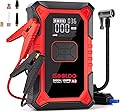
- If you want jump starting and tire inflation in one box, a combo unit like the GOOLOO A3 ($69.98) saves trunk space.
- If budget is tight, spend under $60 but do NOT go below 400 true cranking amps for a standard passenger car.
- If you park outdoors in extreme cold, look for units rated to -20°F or below and choose lithium iron phosphate chemistry over standard lithium polymer.
- If simplicity matters, get spark-proof and reverse-polarity protection as non-negotiable minimums.
Peak Amps vs. Cranking Amps
What It Actually Means
Every jump starter box leads with a big number: 3000A, 4000A, 5000A. That number is peak amps, which is the maximum current the battery can discharge for a fraction of a second under ideal, lab-controlled conditions. It almost never reflects real-world starting power.
Cranking amps (CA) is what matters. That's the sustained current delivered at 32°F for 30 seconds. Cold cranking amps (CCA) goes further, measuring the same at 0°F. Your car's dead battery needs sustained current to spin the starter motor, not a single instantaneous spike.
A unit advertised as "4000A peak" might deliver 400-600 actual cranking amps, which is enough for most passenger cars. A unit advertising "5000A peak" might deliver less than that if the chemistry and internal wiring are cheap. Manufacturers are not legally required to publish cranking amps, which is why so many skip it.
What I Recommend
Always look for published cranking amps, not just peak amps. If a product page only lists peak amps, treat it as a yellow flag. For a standard 4-6 cylinder gas engine, 400+ cranking amps is fine. A V8 or diesel engine wants 600+. When cranking amps are not listed, read the 1-star reviews. People whose trucks wouldn't start are telling you the real number.
Battery Capacity and Chemistry
What It Actually Means
Capacity is measured in mAh (milliamp-hours) or Wh (watt-hours). Wh is more honest because it accounts for voltage. A 20,000 mAh at 3.7V is actually less energy than a 20,000 mAh at 7.4V, but companies rarely clarify voltage when advertising capacity. Watt-hours cuts through that noise.
For jump starting alone, 10-12Wh is enough for a single jump on a healthy battery. But most people also want the power bank function. For charging phones and tablets, 15,000-20,000 mAh (roughly 55-74Wh) gives you multiple phone charges and still handles a jump or two. The S ZEVZO ET03 ($56.99) publishes its Wh figure (74Wh) so you can actually compare it fairly against competitors.
Chemistry matters too. Lithium polymer (LiPo) is lighter and cheaper but degrades faster and performs worse in cold weather. Lithium iron phosphate (LiFePO4) costs more, lasts longer, often 1,000+ charge cycles versus 300-500, and handles cold better. Not every manufacturer specifies which one they use, but if they mention LiFePO4, that's a genuine advantage.
What I Recommend
Look for Wh rating, not just mAh. If the listing only shows mAh, that's not automatically bad, but you can't fully compare it to competitors without knowing voltage. For most people, 50-75Wh is the sweet spot between jump-starting headroom and portable-charging usefulness. Anything under 40Wh feels stingy once you've drained it on a cold morning jump and have no phone power left.
Safety Protections
What It Actually Means
This is the area where cheap units cut corners and people get hurt. A quality jump starter should protect against at minimum:
- Reverse polarity: You connected the clamps wrong. The unit should detect this and refuse to send current, not spark or fry your car's ECU.
- Overcharge protection: Prevents the internal battery from being damaged during charging.
- Short circuit protection: If the clamps touch each other before connecting to the battery, nothing bad happens.
- Over-temperature protection: Cuts power if the unit gets too hot.
- Spark-proof clamps: The clamps don't arc when you connect them to a live circuit.
The NOCO Boost series, including the NOCO GB40 ($99.95), became the benchmark partly because their "UltraSafe" protection is genuinely strict about reverse polarity, refusing to activate until the clamps are correctly connected. Some users find this annoying when their battery is deeply discharged, but I'll take annoying over a fried alternator.
"SuperSafe" branding on units like the GOOLOO GP4000 ($89.99) follows a similar approach. The important thing is to read how the protection actually works, not just that it exists.
What I Recommend
Reverse polarity protection and spark-proof clamps are non-negotiable. Everything else is a nice bonus. If a product page vaguely says "8 protections" without naming them, ask yourself why they won't just list them. A brand confident in their safety engineering will name each one specifically. Do not skip this factor to save $15.
Engine Size Compatibility
What It Actually Means
Every jump starter lists a gas-liter and diesel-liter compatibility rating. These indicate the largest engine displacement the unit can reliably start. Gas engines are easier to start than diesel engines, which is why the diesel rating is always lower. A unit rated for "10.0L gas, 6.5L diesel" is appropriate for almost every consumer vehicle on the road, including full-size pickup trucks.
The numbers come from a combination of peak amps and internal resistance. A unit with high peak amps but high internal resistance will underperform against its rated engine size in real conditions, especially cold starts. This is where cheaply built units claiming massive amps fall apart.
For a typical sedan or small SUV with a 2.0-3.5L gas engine, almost any unit rated for 6.0L+ will work. Where engine size compatibility actually matters is for V8 trucks, large SUVs, diesel work trucks, and RVs. If that describes your vehicle, pay close attention and choose a unit with a diesel liter rating at or above your actual engine size.
What I Recommend
Match the diesel liter rating to your engine if you drive diesel. For gas engines, any unit rated to 6.0L+ handles everything from a Civic to a half-ton pickup without stress. Don't pay a premium for a 10.0L gas rating if you drive a Corolla. That headroom is genuinely useful for people with big engines, and frankly irrelevant for everyone else.
The Features That DON'T Matter
Peak amp numbers above about 2000A for passenger cars. A 5000A unit and a 1500A unit often deliver nearly identical real-world results on a standard car battery. The peak amp arms race is pure marketing.
Built-in flashlights. Yes, they're there. No, they're not a reason to choose one unit over another. Your phone has a better flashlight.
The number of USB ports. Three USB-A ports sounds great. But if none of them charge faster than 5W, they're useless for modern phones. One USB-C port with 18W+ output is worth more than four slow ports.
"Military grade" or "aerospace grade" claims. These phrases mean nothing specific on a consumer product label.
LCD displays showing exact voltage. Nice to have if you want to monitor your car battery health, but not a reason to pay $20 more. Most people glance at it once and forget it exists.
My Buying Checklist
Before you buy, confirm the listing answers YES to each of these:
- [ ] Cranking amps are listed, not just peak amps
- [ ] Reverse polarity protection is explicitly named
- [ ] Spark-proof clamps are confirmed
- [ ] Wh (watt-hour) rating is published, or mAh and voltage are both listed
- [ ] Gas liter rating exceeds my actual engine size
- [ ] Diesel liter rating exceeds my engine (diesel drivers only)
- [ ] Operating temperature range covers the coldest weather I drive in
- [ ] USB-C output is at least 18W if I plan to charge modern devices
- [ ] Cable length is at least 18-20 inches, since short cables make under-hood work frustrating
- [ ] Unit has been reviewed by people with the same engine type as mine
Frequently Asked Questions
How often does a portable jump starter lose its charge just sitting in my car?

Most lithium-based units self-discharge at roughly 1-3% per month in moderate temperatures. In a hot car parked in summer sun, that rate climbs. Realistically, if you charge it fully and leave it in your glovebox, it will still have usable charge after 3-4 months. I recharge mine every two months as a habit, and it's never let me down.
Can a jump starter damage my car's electronics?

A quality unit with proper reverse polarity and over-voltage protection will not damage your car's ECU or electronics when used correctly. The risk comes from cheap units with no real protection, or from incorrect clamp connections on any unit. Always connect red to positive, black to negative, and confirm polarity before activating the unit.
Is a higher mAh rating always better for the power bank function?
Not always. A 30,000 mAh unit at 3.7V contains less actual energy than a 20,000 mAh unit at 7.4V. Compare watt-hours when the information is available. Also consider that larger capacity means more weight and bulk. A 74Wh unit in a compact form factor is often more practical than a 100Wh brick you leave at home because it's too heavy.
What's the difference between a jump starter and a battery maintainer?

A jump starter delivers a burst of high current to start a dead or low battery, then disconnects. A battery maintainer, also called a trickle charger, connects to a car battery over hours or days to slowly restore full charge. Jump starters do not replace maintainers for deeply discharged or sulfated batteries. If your battery dies repeatedly, it needs to be tested or replaced, not just jumped.
Do these work on motorcycles, boats, or ATVs?
Yes, with caveats. Most 12V jump starters work on any 12V lead-acid battery system, which includes most motorcycles, small boats, and ATVs. The key is ensuring the cranking amps are appropriate for the smaller engine, which most units handle easily, and that the clamps fit the battery terminals. Some marine and powersport batteries have non-standard terminal configurations that require an adapter.
Related Reading
Written by Alex Mercer. How We Review.
Products Mentioned
Buy NOCO Boost GB40: 1000A UltraSafe Jump Starter – 12V Lithium Battery Booster Pack, Portable Jump Box, Power Bank & Jumper Cables - for 6.0L Gas and 3.0L Diesel Engines: Jump Starters - Amazon.com ✓ FREE DELIVERY possible on eligible purchases
Buy GOOLOO GP4000 Jump Starter 4000A Peak Car Starter (All Gas,up to 10.0L Diesel Engine) SuperSafe 12V Lithium Jump Box,Auto Battery Booster Pack,Portable Power Bank with USB Quick Charge and Type C Port: Jump Starters - Amazon.com ✓ FREE DELIVERY possible on eligible purchases
Buy S ZEVZO ET03 Car Jump Starter 4000A Jump Starter Battery Pack for Up to 8.0L Gas and 7.0L Diesel Engines, 74Wh Portable 12V Jump Box with USB Ports, LCD Display, Storage Case, and LED Light: Jump Starters - Amazon.com ✓ FREE DELIVERY possible on eligible purchases
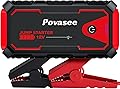
Buy Povasee Jump Starter 5000A Car Jumper Starter, Model A30 12V Jump Box for Car Battery up to 10L Gas or 8L Diesel Engine Battery Jumper Starter Portable with Power Bank/Dual Output/LED Light: Jump Starters - Amazon.com ✓ FREE DELIVERY possible on eligible purchases
Buy GOOLOO A3 Jump Starter with Air Compressor, 3000A Portable Car Battery Booster (9.0 Gas/6.5L Diesel) with 150PSI Auto-Shutoff Tire Inflator, 12V Supersafe Lithium Jump Box Car Battery Jumper Starter: Jump Starters - Amazon.com ✓ FREE DELIVERY possible on eligible purchases